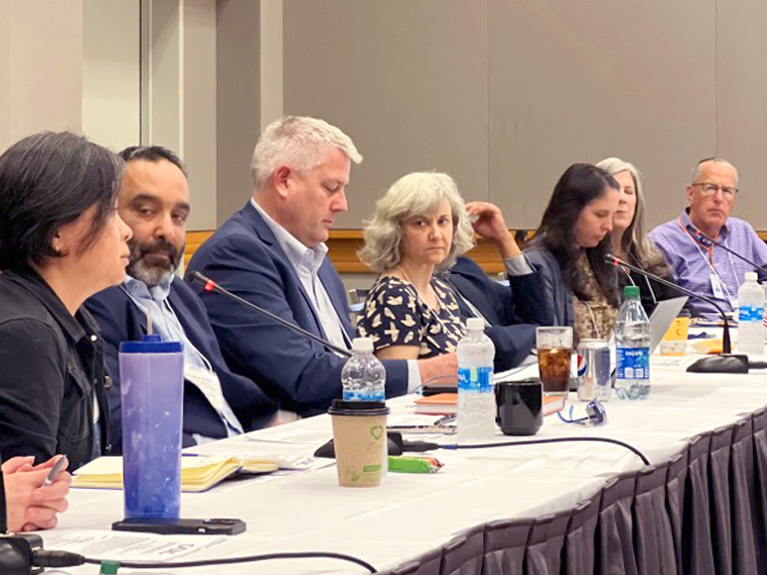
 C-TAC hosted a multi-payor learning collaborative convening in Portland, OR on June 12th in partnership with the America’s Health Insurance Plans (AHIP) Summit. The multi-payor collaborative convenes health plans, integrated delivery systems, accountable care organizations, and other stakeholders to innovate and deliver better care for people with serious illness and their families, share best practices for addressing the needs of those with serious illness, and identifies and prioritizes opportunities and challenges to inform future actions by participants and others.
Dr. Patrick Courneya, C-TAC board member, former chief medical officer, and current senior advisor to HealthPartners, facilitated the convening of stakeholders that focused on addressing the scaling of care and delivery models for seniors with serious illness and the needs of Medicaid and dually eligible populations.
Mark Ganz, a C-TAC board member and president emeritus of the Cambia Health Foundation (CHF), kicked off the meeting by challenging the status quo in order to find effective ways to address Portland’s growing healthcare needs in treating people with serious illness. Inspired by his father’s compassionate care for people with serious illness, he sees the work of CHF as a catalyst for change.
Ganz stated that, “The work that C-TAC does is critically important, and I thank [everyone] for engaging with one another, collaborating, and creating a more person-focused healthcare system.”
The president of the Cambia Health Foundation (CHF), Peggy Maguire, a long-time C-TAC partner and supporter, focused her remarks on the importance of palliative care in the healthcare system. CHF has invested $55 million in palliative care over the years, ensuring that the needs of individuals and their families are met holistically. Maguire emphasized the importance of providing comprehensive social support beyond medical treatment, for example, counseling services for family members, even if they lack insurance.
Peggy Maguire summed up her remarks by stating, “This isn’t about a return on investment, it’s a return on humanity.”
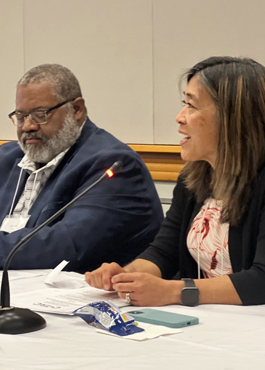 Karen Schulte, president of the Medicare Division at SCAN Health Plan, shared SCAN’s mission to serve and empower seniors and promote their health and independence. She spoke about the complexities and challenges of transitioning from palliative care to hospice and stressed the need for education and support during this crucial phase. Drawing from her personal experience as a caregiver for her late mother, Schulte advocates for the inclusion of hospice care coaches, and highlighted the importance of symptom burden assessment.
Karen Schulte stated, “As much as I thought I understood the business, I didn’t understand what the transition from palliative to hospice entailed.”
Eric Hunter, president, and CEO of CareOregon, and AHIP board member, led the discussion on Medicaid policy, Medicare plan administration, the integration of physical and behavioral healthcare, and how to think outside of the box to improve care for Medicaid and D-SNP beneficiaries with serious illness. Hunter shared CareOregon’s approach to caring for people with serious illness, the investments they have made, and the approach to scale that they plan to take with the HealthRight Group with the goal of bringing innovation to deliver equitable care to underserved populations.
Rebecca Ramsey, CEO of Housecall Providers, that provides home-based primary care, advanced illness care, and hospice, led the conversation on leveraging CMMI models and demonstrating ROI in the Medicaid population. She specifically spoke about alternative models of care for people who are homeless and who would not choose hospice even if they are accessible to hospice. They are typically younger, have higher prevalence of co-occurring mental health and SUD, often have lower health literacy, sometimes face food insecurity and transportation challenges, and typically have less social support.
Ramsey noted that Medicaid enrollment is growing across every state, including those that haven’t expanded Medicaid, and states are increasingly requiring palliative care access for Medicaid enrollees, and she expects this trend will continue. She credited the policy advocacy of C-TAC and CAPC for this accomplishment.
Dr. Andy Mendenhall, CEO of Central City Concern, hosted a site visit of the Transitional and Recuperative Housing Units at Central City Concern, in downtown Portland, where people with serious illness experiencing homelessness can be cared for safely. Following the site visit there was a community conversation about what it takes to develop an effective collaboration, bringing together community-based organizations, business partners, health systems, and state leaders to transform care for people with serious illness.
A New Healthcare Model
A focal point of the convening was the new HealthRight Group, a mission-driven not-for-profit healthcare organization, formed from the merger of CareOregon and the SCAN Health Plans. The new entity aims to combine CareOregon’s Medicaid background and SCAN’s Medicare Advantage expertise to improve access for underserved populations. Upon completion of the transaction, the organizations will operate under the HealthRight umbrella, share $6.8B revenues, and serve 800,000 health plan members in its Medicare/Medicaid managed care offerings.
HealthRight represents a transformative way forward for not-for-profit managed care organizations that operate at a disproportionate scale to for-profit plans. Mergers of two complementary organizations such as CareOregon and SCAN can provide stronger foundations to their beneficiaries and increase community investments/impacts. One example is the organizations’ recently issued grants to RIP Medical Debt, thereby abolishing $110 million in medical debt for nearly 70,000 beneficiaries across Arizona, California, Nevada, Oregon, and Texas.
HealthRight will manage various service divisions from both organizations, such as Welcome Health, a geriatric home-based primary care medical group, and Housecall Providers, an in-home primary and palliative care provider. Other units include MyPlace Health, a Program of All-inclusive Care for the Elderly (PACE) organization that’s a joint venture of SCAN and Commonwealth Care Alliance (CCA); Healthcare in Action, a medical group serving those experiencing homelessness; and HomeBase Medical, a medical group working to deliver chronic disease management and palliative care for Medicare beneficiaries.
These service units amplify their impacts by forging valuable partnerships with local non-profit entities. For instance, HouseCall Providers collaborates with Central City Concern (CCC), a Portland-based non-profit providing comprehensive services for those living through homelessness and addiction. To fully realize the goal of delivering quality care to homebound and the chronically ill members, these partnerships have made significant strides in addressing complex social determinants of health, across housing, healthcare, and employment sectors, for vulnerable demographics.
The transformative impacts of stable housing on healthcare outcomes demonstrates this collaboration is a game-changing blueprint for similar programs in communities across the country. This partnership is further strengthened by the Oregon 1115 Waiver, which granted the state $1.1 billion in new federal funds to incentivize innovative healthcare delivery and financing. In providing the necessary flexibility and resources, collaborations such as that between HouseCall Providers and CCC, can thrive and create lasting change. The goal is to provide a model of care that addresses housing instability and fosters healthier, more equitable communities.
Participants included: Advocate Aurora, AHIP, Blue Cross Blue Shield of Alabama, Blue Cross Blue Shield of Arizona, Blue Cross Blue Shield of Massachusetts, Blue Shield of California, Bon Secours Mercy Health, Cambia Health Foundation, Cambia Palliative Center of Excellence, CareFirst, Caremore and Aspire, CareOregon, Cedars-Sinai, Centene, Center to Advance Palliative Care, Central City Concern, Cigna, Community Care, CVS Health, Elevance Health, Empassion, HealthPartners, HealthRight, Housecall Providers, Kaiser Permanente, Northeast GA Health System, Ochsner Health, One Community Health, Oregon Health & Science University, Peterson Center on Health, Prominence Health Plan, Providence Health Plan, SCAN Health Plan, SNP Alliance, Sutter Health, West Health and WVP Health Authority
The Collaborative’s next convening will be at the C-TAC – CAPC Leadership Summit, Oct. 23-24, 2023, in Washington, DC. Register here for the Leadership Summit.
About C-TAC’s Multi-Payor Learning Collaborative
C-TAC’s Multi-Payor Learning Collaborative brings together leaders of health plans, integrated delivery systems, accountable care organizations, foundations, and other stakeholders to innovate and deliver better care for people with serious illness and their families. In 2022, the multi-payor workgroup piloted to convene renowned champions in their respective fields to share their information and insights on serious illness care delivery and initiate innovative approaches to advance the field. The outcomes include a payor guide for Designing and Implementing Community-Based Palliative Care and an update on the Advanced Care Transformation Report.
In 2023, the collaborative has continued to define standards of services for people with serious illness and convened to explore best practices, lessons learned, and opportunities for future collaboration. In January, C-TAC conducted a survey of collaborative members to consolidate how organizations make an impact in advance care in their own ways, including expanded medical policies/benefits, case management initiatives, and provider network strategies. The collaborative is working to develop pilots for home-based palliative care and opportunities to disseminate learnings and findings. There are currently over 60 payors in the collaborative seeking to expand learning, sharing more data, and accelerating action.
For more information about C-TAC’s Multi-Payor Learning Collaborative, contact Luke Scuitto.