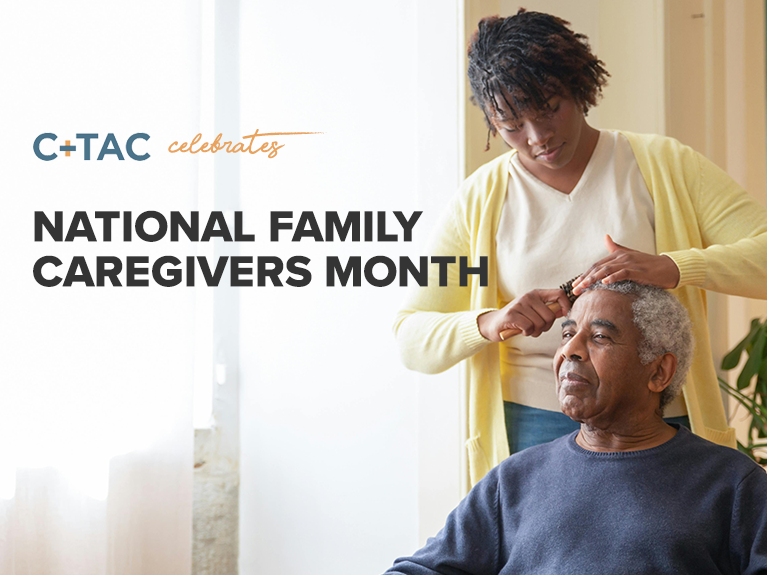
 Recently, C-TAC Public Policy Advisor Brian Lindberg interviewed Mike Wittke, Vice President for Research & Advocacy of the National Alliance for Caregiving (NAC) on his perspective on C-TAC’s Core Principles for Care Models with serious illness populations.
As VP for NAC, Mike has a deep understanding of the roles and responsibilities that caregivers take on and how our fragmented and siloed health care system affects caregivers. Caregivers of people with serious illness face some of the biggest challenges that the system has to offer. Mike supports C-TAC’s work to create supports and consistently high-quality care for individuals with serious illnesses and their caregivers.
Brian Lindberg: Mike, thanks so much for contributing to our efforts to ensure that those with serious illness and their caregivers have the best possible care. Let’s go thru each of the eight principles so that we can get a comprehensive view of NAC’s positions and perspectives.
Principle 1. Care is person- and family-centered, improving quality of life.
Mike Wittke: I like that you have this as the first aim, because it’s fundamental for how we approach the health care enterprise. Caregivers need support to continue to provide care and to care for themselves. Recognizing the value – the contributions, the expertise, the economic and health impact – of what caregivers do, as partners in innovation, is a key part of creating a more equitable, person- and family-centered health care system.
Principle 2. Care is inclusive – reducing inequities and disparities, and removing barriers to access and to quality care.
Mike: Again, this is fundamental, and I would even go further: For meaningful patient and family engagement in U.S. health and social care systems, it is critical to prioritize actions that lead to a more inclusive system of services and supports that intentionally addresses health disparities and systemic barriers by integrating diverse populations into research, policy, and program design.
Principle 3. Each person’s physical, social, psychological, and spiritual needs are assessed on an ongoing and standardized basis.
Mike: Yes, this is meaningful for both patients and caregivers. It is critical that state and local entities define and implement caregiver assessments for use across state agencies and, when possible, in coordination with other entry points within health care settings and social services. These assessments should be standardized so that information can be compared across state agencies that (a) deliver services and supports to anyone over the age of 18 with a serious condition or disability or any older adult who relies on assistance for ADL’s or IADL’s from a family caregiver or (b) directly serve family caregivers, allowing for secure data-sharing across agencies.
Principle 4. A care plan is developed, using shared decision making, based on those needs and the person’s individual goals and preferences.
Mike: Shared decision-making is still a relatively new concept in most health care settings so this should be emphasized as much as possible since it sets the stage for the approach to care. States should support integration of family- and person-centered approaches to shared-decision making that recognizes caregiver autonomy in care settings and in health care policy (at the individual and community level).
Principle 5. Care is provided by a qualified core interdisciplinary team, with additional team members as needed.
Mike: This aim helps address the silo problem. We’ve done that with the promotion of the state-based Caregiver Advise Record Enable (CARE) Act. CARE recognizes caregivers as members of the interdisciplinary care team, especially in hospital-to-home transitions. Part of supporting an interdisciplinary team is making sure that communication is thorough and, in the case of caregivers, training on medial/nursing tasks following hospital discharge.
Principle 6. Care is accessible 24/7 (using technology as appropriate) and available throughout the continuum of a serious illness (including in the home when appropriate).
Mike: This aim has grown in salience due to COVID-19. Facilitating better access to programs, services, and resources to patients and caregivers through technology, especially in rural areas, is often very convenient and may help improve health outcomes, assuming the use of technology is not counter-productive to the needs of the caregiver or person receiving care.
Principle 7. Care is comprehensive, coordinated, with seamless transitions, and with the integration of clinical and community-based services and supports for the person and family caregiver(s).
Mike: Care coordination efforts are of particular concern for caregivers as the complexity of care is increasing. There is a need to better equip systems to play a greater role in coordinating caregiver supports and services across the range of chronic conditions and recognizing challenges related to co-morbidities for the care recipient. A greater proportion of caregivers of adults report their recipient is dealing with multiple condition categories. Therefore, we believe that “comprehensive” and “coordinated” really need to be highlighted.
Principle 8. Payment is value-based, available to qualified organizations of any size, and includes risk adjustment, upfront investment, accountability, standardized metrics, and quality improvement, and covers both clinical and social services.
Mike: A better understanding of the incentives available to providers to identify and support caregivers can help address the gap between the need for these services and awareness and use of them by providers. As stated here, both clinical and social services need to be addressed in the cost-benefit calculations.
Brian: Thank you so much for sharing you views on what we at C-TAC believe are foundational principles for providing health care and supports and services to individuals with serious illness and supporting their family caregivers. The role of caregivers is critical in helping to ensure that quality care and services are provided, and the individual’s care preferences are respected and followed.
Core Principles align with the evidence-based 4th edition of the National Consensus Project Clinical Practice Guidelines.