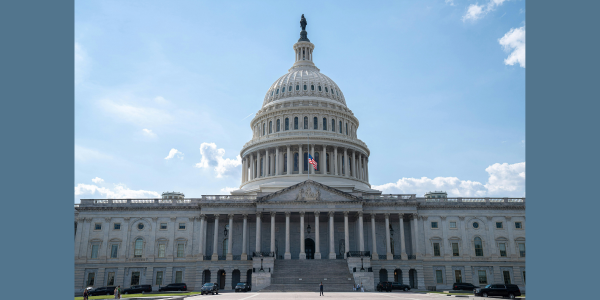
Earlier this month, Congress ended a partial government shutdown by approving a five-bill appropriations “minibus” to fund the federal government through FY26. This marks a return to greater funding stability following a series of short-term continuing resolutions that created uncertainty for providers and patients alike.
Those stop-gap measures repeatedly tied key health policies — including Medicare telehealth flexibilities and the Hospital-at-Home initiative — to temporary extensions, contributing to care disruption risk during funding lapses. The new package, particularly the Labor, Health and Human Services, and Education (LHHS) division, provides $194.9 billion in discretionary funding, signaling a shift back toward full-year appropriations and improved policy predictability across the healthcare sector.
Key Healthcare Provisions
Funding Stability
- $194.9 billion in LHHS discretionary funding
- Support for workforce development, public health, biomedical research, education, and social services
- Return to full-year appropriations after repeated short-term extensions
Medicare
- Maintains special payment adjustments for low-volume and Medicare-dependent hospitals
- Extends add-on payments for ambulance services
- Preserves certain antiviral drug coverage under Part D
- Modifies hospice payment caps
- Extends pandemic-era telehealth flexibilities through December 31, 2027, including:
- Removal of geographic restrictions
- Expanded originating sites
- Broader practitioner eligibility
- Continues Medicare reimbursement for Hospital-at-Home services through 2030
Medicaid
- Delays Disproportionate Share Hospital (DSH) cuts until FY 2028
- Broadens state flexibility in calculating uncompensated care costs
- Streamlines enrollment pathways for certain out-of-state pediatric providers
Pharmacy Benefit Manager (PBM) Reform
- Requires rebate pass-through
- Mandates transparent pricing
- Delinks compensation from drug prices
- Directs CMS to establish fair pharmacy contract standards
Collectively, these provisions reinforce access to care, stabilize key safety-net programs, and extend delivery system innovations that are particularly important for individuals managing serious illness and complex care needs.
C-TAC is undertaking a comprehensive review of the FY26 Consolidated Appropriations Act and will release a detailed, standalone analysis coming soon!