

Messages come in many forms—some are encouraging, while others leave us shaking our heads in disbelief. Yet, messages are not conveyed solely through our words; they are often most evident in our daily actions.
Just the other day, my husband, Bernard, remarked, “Well, I guess you’re not cooking today; I don’t smell anything coming from the kitchen.” He wasn’t wrong—my actions had sent a clear message that his dinner would be prepared by one of our local restaurants.
On a more serious note, this simple exchange led me to reflect on an important question I often consider when engaging with community stakeholders: What messages are we conveying through our interactions as healthcare professionals—with patients, caregivers, and the communities we serve?
Recently, Dr. Anthony Bach and Dr. Marian Grant, shared findings with the Message Lab Partners on their recent qualitative research study entitled “Understanding and Reframing Palliative Care for Diverse Patients, Community Leaders, and PC Clinicians”. They utilized the Zaltman Metaphor Elicitation Technique (ZALT), originally created at the Harvard Business School Mind of the Market Lab (https://www.olsonzaltman.com/zmet). This method was used with the following geographically diverse groups for their research.
- Patients (Black/African American, Asian /Asian American, Hispanic/Latino
- Racially Diverse Palliative Care Clinicians
- Diverse Trusted Community Leaders and Advisors
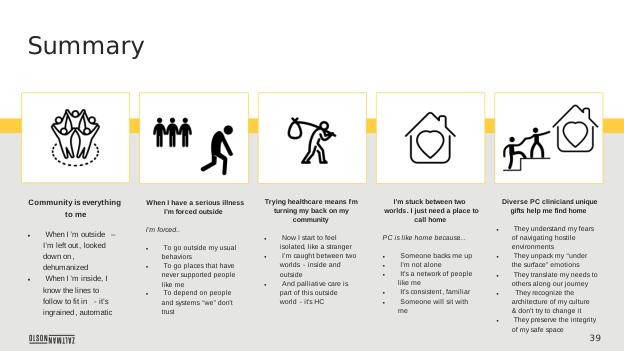
The diagram summarizes patients’ perceptions and needs regarding palliative care.
This summary gives us the recipe or path forward to create and design our palliative care services to reflect “home”. I’ve often heard the words quoted “People do not care how much you know, until they know how much you care.” The following examples are effective methods for creating a palliative care environment whose impact resembles “home”.
Finally, we must remain committed to consistently evaluating our impact in supporting patients across all segments of our diverse healthcare landscape—rural and urban, underserved and under-resourced. We must continue to be diligent in the following areas:
- Develop a deep understanding of cultural and family norms by building authentic relationships with trusted community leaders and cultural brokers.
- Ask open-ended questions to encourage storytelling, providing valuable insights into what matters most to patients.
- Avoid one-size-fits-all approaches; instead, co-design care plans that address the unique needs of each patient and their caregivers.
- Honor and safeguard trust—speak with honesty, follow through on commitments, and demonstrate that integrity is at the heart of all interactions.
To learn more about our Serious Illness Messaging Principles and Took Kit click here


