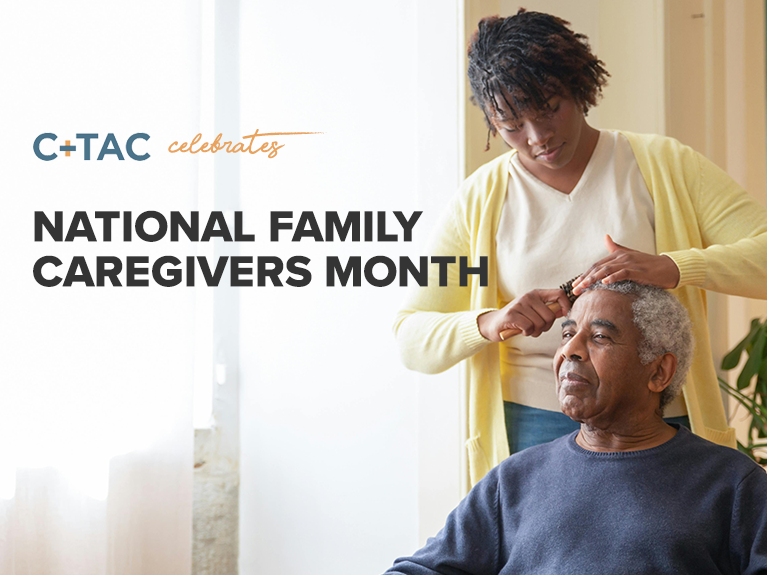
National Caregivers Day is Friday, February 18th and serves as a dedicated time to honor and uplift the selfless individuals who care for those in need of assistance in their daily life due to illness, injury, or disability. This is the focus of a distinct group of leaders in the District of Columbia every day of the year. The DC Coalition to Support Caregivers is a group of faith-based leaders and community partners working to make a difference for and to support unpaid caregivers. C-TAC is a part of an ongoing collaborative project with a Coalition in the District’s Ward 7 – a region full of vibrant but medically under-resourced and under-served communities of color. As a part of a multisector collaborative that includes organizations like Capital Caring Health and ARCHANGELS with funding support from Cigna Foundation, community leaders in Ward 7 are making strides to improve the lives of caregivers.
Our collaborative work with community leaders and organizations in the DC Coalition is meant to help address health disparities and advance health equity. This is a central component of our Core Principles for Care Models and aligns with CMMI’s vision, which includes health equity as a key component.
In 2021 we joined leaders from the DC Coalition and set out to increase shared knowledge of the support needs of caregivers by hosting listening sessions and hearing directly from community members in Ward 7. These efforts helped them gain critical insight on the needs and concerns of caregivers and the results of the sessions will guide the D.C. Coalition to create education, provide resources, and garner support from other appropriate community partners. Throughout the listening sessions, community members expressed concerns over challenges to maintaining their own wellness, accessing resources, and long-term financial security. According to ARCHANGELS, Ward 7 caregivers who participated reflected a lower intensity of strain due to their caregiving responsibilities than caregivers around the country. The support provided by faith-based communities was identified as a possible reason for this variation.
A project leader and listening session facilitator, Geri Feaster, MS, RN, highlights the unique community-centered nature of the listening session that created a “safe space” for residents to share personal experiences and express their needs, such as;
- Opportunities for respite care to temporarily relieve them of their caregiver duties
- Financial support to meet their basic needs and services
- Programs to increase knowledge of specific resources for caregivers’ holistic needs
Faith-based communities are at the core of these collaborative efforts. The leadership of Reverend George C. Gilbert Jr. of Holy Trinity Baptist Church church in the Ward 7 collaborative exhibits a central focus on ensuring that these efforts are community-driven and empower residents to take ownership of the project’s direction. Reverend Gilbert expresses that faith-based communities can provide crucial support to caregivers:
“Community support provides advocacy, organizing, education, and resources to amplify the campaign, work, and needs of caregivers. It is the Black church that has been the center point in the Black community, and stabilizes, transforms, and provides a moral compass [throughout]…the nation.”
Reverend Gilbert’s words resonate with the greater needs of caregivers, especially in DC’s Ward 7 where the majority of residents are Black and churches can serve as anchors for community works. From his perspective, caregivers need, “a two-fold voice, a voice for personal needs, and a voice as a collective organized body.” Reverend Gilbert believes these multiple levels of organization will enable effective distribution of information and data, provide platforms to share personal stories, and lead to policy changes that improve the lives of caregivers.
Reverend Gilbert expresses the need for responsive leadership from policymakers and healthcare providers, “[politicians must] understand the sacrifices of careers, finances, and time that caregivers endure making life sustainable for others in need. That should be protected and rewarded. Healthcare providers need to be personal, relatable, informative, and professional.”
Project leaders continue to work with and elevate the insights shared by the Ward 7 community and know that there is still much more to do. To ensure that community members see the change that their stories and experiences are driving, communication and increased education of resources and needs of caregivers is essential.
To learn more about the work of the DC Coalition to Support Caregivers, contact Reverend George Gilbert at georgegilbert01@aoldenburg.
Written by: Andrew Lozano, C-TAC Communications Specialist