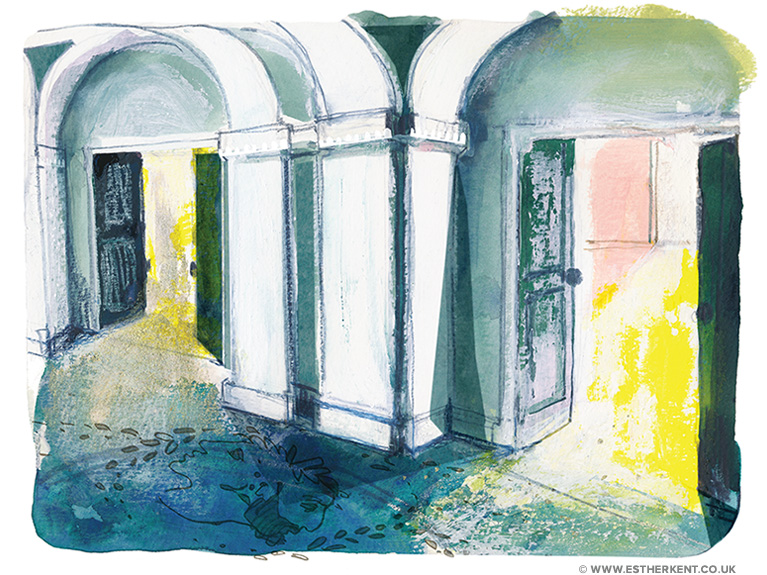
This is the first essay in a series by CEO, Jon Broyles. Each essay in the collection will explore a personal point of view and reflection. Custom illustrations are crafted by artist and illustrator, Esther Kent.
“In the very idea of a story there is something to do with shelter, the shelter of the voyager or the traveler who has survived to tell the story…” – John Berger on Storytelling
It was on a humid day in West Virginia many years ago that I first heard about the Voyager.
It was my great Uncle Fred Helvey’s funeral service. We were all there in the old Tabernacle as they called it. Sitting there on the wooden benches there wasn’t much ornamentation to distract you from the preacher. It’s the kind of place where you wouldn’t be surprised if a cow poked her head in through the window, not sure if you or she were out of place.
The preacher was talking about Uncle Fred and I was trying to keep from crying. So I thought what Fred would make of all this. And I thought about his jokes.
I liked Fred’s jokes and he didn’t mind them either. He had a recurring one he’d use on me at the family reunion picnic every year. What’re you studying in college, son? Philosophy, Uncle Fred. He looked down at his plate. Looked back at me and, taking his time and turning his head to the side, serious-like, say: Well, that and a nickel should buy you a stick o’ gum. And then he doubled over, laughing and laughing.
What would he make of this somber affair taking place now? I wished he’d jump through the door and say how he’d fooled us all.
And Fred, the preacher was continuing all this time as I was lost in my head, part of his legacy’s still out there, flying through space…Yes that’s right, flying through space right now on the Voyager. He developed a small part that’s still on that spacecraft.
I was paying attention now and wanted to know more. But that was it. Fred had designed a small part on a spacecraft that was launched nearly 50 years ago and is – thanks to momentum – set to continue flying for the next billion years.
Now Fred was gone. Growing up I’d wanted to record his stories, because I knew that he had them. Stories about how the family of nine had 10 cents in the house when their dad died at the dinner table one night; and Fred and brothers made it through the Great Depression, farming and helping their young, widowed mother. But I’d never gotten around to it.
After Fred’s passing something started working away at me. It had to do with listening.
Look all around and there are so many people with stories to tell. Walk into a nursing home and you’ll feel it, like you can feel on a Summer’s day when it just needs to rain. People there who are rich in stories of what they’ve seen, felt, and hoped for. And now they’re slipping away, too many sitting by themselves watching television or slumped over in a chair.
Listening. What is a story if it’s never heard?
A secret?
No one wants that, especially about the things we really care about.
It’s more like an unopened present.
My 5 year old tugs at my arm: Daddy, Daddy, DADDYYYYYYGRRRRR!!! Yes – what is.. [Coffee spills all over my shirt] – Lucy, what is it? Daddy, I – want – to – show – you – my – PICTURE.
Kids get it. There’s a need to share. And that’s all the more true at the other end of life.
Uncle Fred passed away nearly 20 years ago now. And today I have the fortune of working (see, Fred, a philosophy degree does pay) with hundreds of others on an urgent mission of transforming care for those with serious illness. And the work doesn’t start with heroic interventions, but with listening: What do you care about most?
You’d think this was crazy in any other line of work. You don’t need to ask someone with a broken arm what they value and what they’d like done. But when it comes to a serious illness that may not yet have a cure, it’s not always clear what’s needed.
Helping someone get to their grandson’s graduation; taking that vacation; or helping them continue to create their art or work their job– whatever the person defines as their goals are valid goals to aim for.
Voyager’s just about left our Solar System. After next year we won’t hear from it again, its power system can’t work the communications anymore.
From there it carries one last story. The story’s captured in a Golden Record onboard, with images, scientific data, music and voices of humanity in it.
It’s a billion-year question whether the Golden Record will ever be heard. And by then Earth and most likely we (humans) will be long gone.
But what if the Golden Records are here? All around us.
Each has in it what we’ve held close and carried with us, as John Berger says, “sheltered from oblivion, forgetfulness, and daily indifference”.
Doesn’t every story deserve to be heard?